
Lesson 05
MOLAP vs ROLAP
Learn MOLAP vs ROLAP: OLTP vs OLAP workloads, cubes, MDX queries, and how BI maturity relates to data salaries and team growth.
MOLAP vs ROLAP
OLTP vs OLAP, cubes, MDX, data maturity and salaries.
OLTP vs OLAP
Before comparing cube types, separate the two kinds of database workload.
| Characteristic | OLTP (transactional system) | OLAP (decision support system) |
|---|---|---|
| Application | Day-to-day operations, production | Analysis, decision support |
| Use cases | Mobile apps and ERP systems such as SAP, Oracle, and Microsoft Dynamics 365 F&O | BI tools such as Power BI, Tableau, and others |
| Users | Information system experts | Decision-makers |
| Data schema | Entity / Relationship | Star / Snowflake / Constellation |
| Normalization | Frequent | Rare |
| Data | Up to date, raw | Archived, aggregated |
| Updating | Immediate, real time | Delayed or postponed |
| Queries | Simple, regular, predefined, predictable | Complex, irregular, unpredictable, ad hoc |
| Query language | SQL, QBE, QUEL | MDX, XQuery, XMLA |
| Analysis axis | One- or two-directional | Multidimensional |
| Operations | Insert, update, cancel | Read, cross-analysis, refresh |
| Data size | Megabytes to gigabytes | Terabytes to zettabytes |
OLTP systems run the business: many small, fast writes against a normalized schema. OLAP systems analyze the business: few, heavy, unpredictable reads over large volumes of historical, aggregated data modeled as a star or snowflake.
Online Analytical Processing (OLAP)
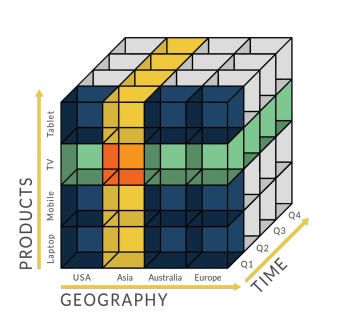
An OLAP cube is data pre-aggregated and cached to a file or to memory. Picture a cube with three axes: Products (laptop, mobile, TV, tablet), Geography (USA, Asia, Australia, Europe) and Time (Q1–Q4). Each cell holds a measure, such as sales for TVs in Asia in Q2. Slicing along one axis gives you a whole row or column of cells at once.
The best-known cube engine is Microsoft SQL Server Analysis Services (SSAS). You query it with MDX (Multidimensional Expressions) instead of SQL:
SELECT
    NON EMPTY TOPCOUNT({[ASIN].[ASIN].Members}, 5,
        ([Measures].[Gross.Profit], [Category].[Category].[LCD])) ON ROWS,
    NON EMPTY {[Category].[Category].[LCD]} ON COLUMNS
FROM [Amazon]
WHERE ([Measures].[Gross.Profit], [Time].[ALL].[AllMember].[2011].[5], [Brand].[Brand].[LG])
This query returns the top 5 products (ASINs) by gross profit in the LCD category, for the LG brand, in May 2011. Rows and columns are axes of the cube, not tables, and WHERE picks a slice of the cube rather than filtering rows.
Cube types: MOLAP vs ROLAP
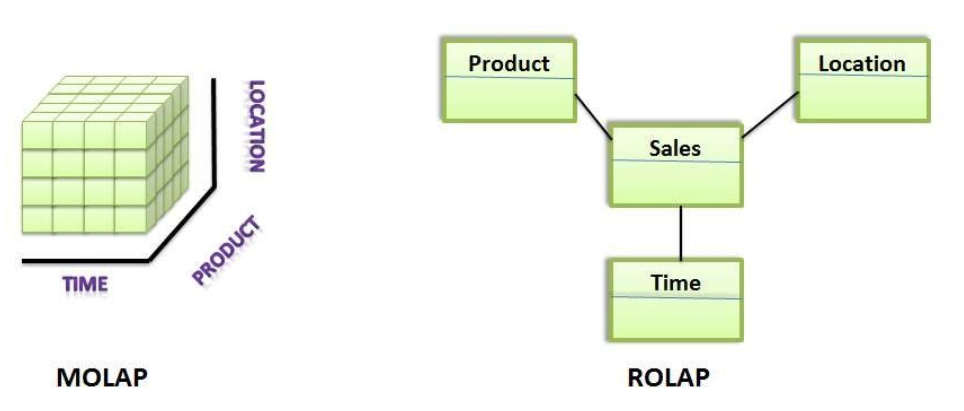
| MOLAP (Multidimensional OLAP) | ROLAP (Relational OLAP) | |
|---|---|---|
| Where the data lives | In a dedicated multidimensional cube (Time × Product × Location) | In relational tables: a Sales fact table joined to Product, Location and Time dimensions |
| Query language | MDX | SQL |
| Caching | The cube itself is the cache, pre-aggregated in advance | Queries run on the database, optionally cached by the BI tool |
| Typical tools | MS SSAS (modern alternative: Tabular Model) | SAP BusinessObjects, Tableau, Power BI |
MOLAP precomputes aggregates into a cube, so reads are very fast, but the cube has to be rebuilt when the data changes. ROLAP keeps the data in a star schema in the warehouse and generates SQL on the fly. This is how most modern BI tools work, and it scales with the power of the database underneath.
Do you need to learn OLAP and MDX?
Only if you want to become an expert in the Microsoft BI stack:
- Analysis Services (MOLAP and Tabular model)
- Integration Services
- Power BI
- SQL Server
- T-SQL
- and later, the Azure cloud
That path makes sense if you want to become a certified Microsoft specialist and set other vendors aside. Even there, modern solutions use the Tabular model far more often than classic MOLAP cubes, so MDX is a niche skill today. For most analysts, SQL on a star schema (ROLAP) is what matters.
This lesson is for members only
Join Surfalytics to unlock all 8 lessons in this module, plus every module, project, mock interview, and the private community.
7-day free trial · Cancel any time